This is a demo store. No orders will be fulfilled.


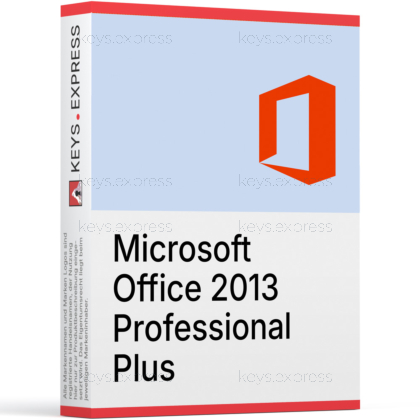
What are the main features and advantages of Microsoft Office 2013 Professional Plus?
Complete Suite – Includes Word, Excel, PowerPoint, Outlook, OneNote.
Business Tools – Adds Access databases and Publisher for professional layouts.
Enterprise Deployment – Supports volume licensing, KMS/MAK, and centralized installs.
Offline Licensing – One-time purchase, works without monthly subscriptions.
File Compatibility – Opens modern Office formats with strong backward support.
Important – Microsoft Visio and Microsoft Project not included.
Thank you for understanding our FAIRPLAY conditions:
You must have a customer account and have purchased products from us within the last twelve months.
Free products are available to each customer only once.
You may order a maximum of three free products.
This product is not posted to the MS account and is not transferable to other devices.
This product allows a one-time activation for one device. Once used, it cannot be used again, not even for the same device.
Download: Office 2013 Professional Plus
Core applications – Word, Excel, PowerPoint, OneNote, Outlook for daily office work.
Access 2013 – Full desktop database tool for tables, queries, forms.
Publisher 2013 – Page layout for flyers, brochures, newsletters, simple catalogs.
Lync 2013 – Business messaging and conferencing client, later renamed Skype for Business.
InfoPath 2013 – Form designer for structured SharePoint and intranet data entry.
Important – Microsoft Teams and Microsoft 365 cloud services are not included.
Office 2013 Professional Plus is the classic perpetual desktop edition of Microsoft Office for Windows, aimed at users and organizations that need the full Pro application range, including Access, Publisher, Lync, and InfoPath. It runs locally without any Microsoft 365 subscription and stores files on the user's own drives or local network.
Complete Pro suite – All Professional Plus apps in one installer.
Local-only operation – Works fully without cloud accounts or sign-in.
Office Open XML – Saves .docx, .xlsx, .pptx by default.
PDF export – Built-in Save As PDF from every core app.
Touch mode – Larger ribbon spacing introduced for tablet hardware.
SharePoint integration – Native support for on-premises SharePoint document libraries.
It installs a complete locally running Office suite on a Windows PC, with Word, Excel, PowerPoint, Outlook, OneNote, Access, Publisher, Lync, and InfoPath. Office 2013 introduced the flat, white Ribbon UI, the Start screen with template gallery, and inline PDF editing in Word ("PDF Reflow"). Files are saved by default in Office Open XML (.docx, .xlsx, .pptx), but the suite still opens legacy .doc, .xls, and .ppt files from earlier Office versions. There is no Microsoft 365 component and no built-in Teams client.
It fits users who maintain older Windows 7 or Windows 8.1 workstations where current Office 2021 or 2024 is no longer supported and a modern Microsoft 365 subscription is not wanted. It is also useful for keeping legacy Access 2013 database front-ends running unchanged, since later Office editions sometimes break older Access macros and forms. Buyers should be aware that Microsoft ended extended support for Office 2013 on April 11, 2023, so no further security updates are released. For machines exposed to the internet or to external file sharing, a newer Office version is the safer technical choice.
Professional Plus is the larger of the two classic on-premises Office 2013 editions and adds Access, InfoPath, and Lync on top of the Standard application set. Standard does not include Access or InfoPath, which matters for anyone running Access database files or SharePoint InfoPath forms. Both editions share the same Word, Excel, PowerPoint, Outlook, OneNote, and Publisher versions, so general office work looks identical. The deciding question is usually whether Access or InfoPath are needed.
| Application | Professional Plus | Standard |
|---|---|---|
| Word, Excel, PowerPoint | ✓ | ✓ |
| Outlook | ✓ | ✓ |
| OneNote | ✓ | ✓ |
| Publisher | ✓ | ✓ |
| Access | ✓ | ✕ |
| InfoPath | ✓ | ✕ |
| Lync | ✓ | ✕ |
| Microsoft Teams | ✕ | ✕ |
Mainstream support ended on April 10, 2018, and extended support ended on April 11, 2023, so Microsoft no longer ships security patches for Office 2013. Microsoft Teams is not part of this suite, and the included Lync 2013 client connects to on-premises Lync or Skype for Business servers rather than the modern Teams service. There is no native OneDrive cloud sync of the kind Microsoft 365 ships today; "Save to SkyDrive" worked at launch but is no longer maintained for current Microsoft cloud back-ends. Real-time co-authoring in the modern sense and the AI Copilot features added in later Office releases are also absent.
It uses Office Open XML as the default save format (.docx, .xlsx, .pptx, .one, .pub, .accdb), and it still opens older binary files such as .doc, .xls, .ppt, and .mdb. Word 2013 can open existing PDF files and convert them into editable Word documents via the "PDF Reflow" feature, and every core app can export directly to PDF with Save As. Outlook 2013 supports Exchange, IMAP, and POP3 mail accounts and stores local mail in .pst and .ost files. Older .doc and .xls files saved long ago will open in Compatibility Mode, which disables a few newer features until the file is upgraded.
No. Microsoft Teams did not exist when Office 2013 was released and is not part of this suite. The included business communication client is Lync 2013, which Microsoft later rebranded as Skype for Business and which connects to on-premises Lync or Skype for Business Server, not to Microsoft Teams. Buyers who need Teams must install it separately as a standalone client or use it through a Microsoft 365 plan.
Yes. Access 2013 is part of the Professional Plus edition and installs the full desktop database application that creates and edits .accdb files. The Standard edition of Office 2013 does not include Access, which is the main reason buyers who maintain Access databases choose Professional Plus.
Yes. It is a one-time perpetual desktop installation of Office that runs locally on Windows without a Microsoft 365 subscription. It is unrelated to the modern Microsoft 365 Apps that update monthly and depend on a Microsoft account.
Yes. Files saved by Office 2013 use the standard Office Open XML formats (.docx, .xlsx, .pptx) and open without conversion in Office 2016, 2019, 2021, 2024, and Microsoft 365 Apps. Some features unique to newer versions, such as XLOOKUP in Excel, will appear only as static results when the file is opened back in Office 2013.
No. Extended support for Office 2013 ended on April 11, 2023, so Microsoft no longer issues security patches or fixes for the suite. For workstations connected to the internet or handling external email and documents, this is an important risk factor to weigh.
| Operating Systems | Windows 8 Windows 7 Windows Server 2012 Windows Server 2008 |
| Processor | 1 GHz x86 or x64 processor with SSE2 support. |
| Memory RAM | 1 GB for 32-bit; 2 GB for 64-bit. |
| Hard Disk | 3.0 GB free disk space. |
| Display | 1024 x 576 screen resolution minimum. |
| Graphics | DirectX 10-compliant graphics card for hardware acceleration. |
| Note | If the required DirectX 10-capable hardware is not present, Office 2013 apps can still run without graphics hardware acceleration. Requires .NET 3.5 or later. |
keys.express and keys.discount are online platforms for product keys. The product keys available in our shops for Windows and other software are inexpensive, secure, legal and come with an activation guarantee.
Below you will find the most important legal information about our products.
We offer exclusively unused and non-activated product keys. The keys have never been redeemed for activation and are fully available to the purchaser for the first-time activation of the respective product. A key that has already been redeemed could no longer be used for a new activation and is therefore not offered by us.
Trading in these product keys is permissible in the European Union and in Switzerland under current case law, provided that the necessary conditions are met. These conditions are as follows:
This trade is legally permissible because the underlying license was already placed on the market with the consent of the rightholder within the EU/EEA or Switzerland in return for appropriate remuneration. As a result, the so-called principle of exhaustion has taken effect, which permits the resale of individual product keys — in particular those originating from volume license agreements. Microsoft or the respective software provider has already received appropriate remuneration for this.
keys.express and keys.discount ensure that the aforementioned conditions are met and that the lawful use of the software is guaranteed. The requirements arising from European legislation are also observed in Switzerland.
Important note: The acquisition of a product key through the transmission of a combination of numbers and letters in digital form does not, in itself, constitute a license for the lawful use of the program. The license only arises from the respective installation and the associated acceptance of the manufacturer's terms of use.
Further information can be found here: